Showing posts with label J.P. Lane. Show all posts

Friday, April 21, 2017

The oil-drenched sea in which the seed for a novel was planted

I was reading the news a few days ago (I must be a masochist) and I saw where the President invited American manufacturers to recommend ways the government could cut regulations and make it easier for companies to get their projects approved. As my eyes moved further down the news report in Washington Post, I saw this on the list of self-serving recommendations: BP wants to make it easier to drill for oil and gas in the Gulf of Mexico by reducing how often companies must renew their leases.

I gritted my teeth. I’m still gritting them, particularly since yesterday, April 20th, was the seventh anniversary of the devastating BP Oil Spill in the Gulf of Mexico. I remember that date as well as I remember the dates on which people dear to me died. A little melodramatic, you say? This picture may change your mind. That's a sea bird, barely alive when that picture was taken.

Photo: Huffington Post
Now imagine what was under the surface. Years of scientific observation of the Gulf following the spill have shown what that was. From a 2015 NBC report:

  • "Nearly five years after the Deepwater Horizon oil spill in the Gulf of Mexico, a new report says that creatures like dolphins, sea turtles and fish still haven't fully recovered.
  • Bottle-nose dolphins were found dead on the Louisiana coast in 2014 at four times historic rates, according to "Five Years and Counting: Gulf Wildlife in the Aftermath of the Deepwater Horizon Disaster," released on Monday by the National Wildlife Federation.
  • Fish including mahi mahi and red snapper, coral colonies, and white and brown pelicans are still struggling. Around 32 percent of laughing gulls have died as a result of the oil spill, the National Wildlife Federation said.
  • Between 27,000 and 65,000 Kemp's ridley sea turtles died during the oil spill and that the number of nests discovered every year since has gone down."


And BP wants to continue drilling, drilling, drilling. Climate warming and the resulting acidification of the oceans because of increasingly high levels of carbon in the atmosphere aside, what guarantees do we have that there will never be more oil spills?

They say the seed for a book is often planted in a significant moment. The one I’m writing now was planted on April 20, 2010 with the event that rocked everyone who gives a damn about the health of our oceans. The seed didn’t germinate immediately. It was a while before it began to sprout and the story grew into two branches - one in 1802 and the other in 2010. Kate, the main character in the 2010 section, isn't anything like me. I'm a creative sort. Kate is a marine and atmospheric scientist, but she speaks for me here as she remembers her reaction to the BP Oil Spill:

"She had not been able to erase the images of the birds and sea turtles that looked as though they had been dipped in tar from her mind. The innocent victims of corruption, greed and the thirst for power. The men on that platform whose lives had been extinguished in a violent explosion of flame had been innocent victims too. Oh God, it was horrifying. It had brought her to tears. Soon those tears had been replaced by a numbing fury that had propelled her into inexhaustible action.

NOAA’s response had been quick. She’d dropped everything and volunteered to help. The Gulf now took precedence over everything else. What they found was bad. The dispersants hadn’t helped. They’d only added to the unholy mess that was a death warrant for thousands of marine species. The first that came to her mind was the dolphins, those gentle, friendly creatures with the same level of intelligence as humans."

Thursday, January 21, 2016

Has love become a second-hand emotion?

There are red hearts all over the place. They appeared in the stores the second all the evidence of the holiday season disappeared in a poof. Love, love, love, love – the centuries-old inspiration for songs, books, poems, letters, journals, plays, movies and even graffiti is about to make its annual rounds again. Sent in text messages, written on cards, whispered between sheets, or shouted from the highest hill, love will be confessed, reaffirmed, renewed, and maybe even discovered, as it is every year on February 14th.

Why a day devoted to celebrating this most celebrated of emotions? Cynics may claim it’s "a Hallmark opportunity,” but card manufacturers can’t seize an opportunity that doesn’t exist. With few exceptions, people need to love and be loved in one way or another. Understanding that there is more than one kind of love, the ancient Greeks had four words for love: éros, love of an intimate nature, sexual passion, philía, affection, friendship, storgē, the kind of love and affection shown between parents and children, and agápe, a more universal type of love such as love for our fellow humans.

Since last Valentine’s Day, there’s been a lot of hatred displayed around the world – in terrorists attacks, war and other kinds of violence, in verbal attacks against some groups by U.S. politicians. There have also been attacks against the environment and attacks against wildlife. It seems there is no end to it. Yet amidst it all, there has been an incredible outpouring of love as people from all over the world have come together to stand by what they believe is right for their countries and the world. This is love in the agápe sense and it's powerful. However, to quote Elie Wiesel, “The opposite of love is not hate, it’s indifference” – that cold eye that observes wrong doing without being motivated to take action against it. Too many of us have become indifferent because of fear or hopelessness, or both. Apathy on a mass scale is snuffing out the light of love almost as fast as the candles are lit.

Let’s not allow love to become a second-hand emotion. Let’s celebrate all the beautiful aspects of it this Valentine’s Day by loving in every way we can. I think Burt Bacharach was on the money with this line from his famous song from the 60s: "What the world needs now is love, sweet love." Listen to it and if you like, take a peek at some of my favorite love quotes while you're listening.


"How do I love thee? Let me count the ways."  Elizabeth Barrett Browning

"I won't stay in a world without love."  Lennon/McCartney

"Love is passion, obsession, someone you can't live without." from the movie Meet Joe Black

Death cannot stop true love. All it can do is delay it for a while."  from the movie Princess Bride.

"He ain't heavy, he's my brother."  Bobby Scott/Bob Russell

"Love doesn't make the world go round. Love is what makes the ride worthwhile."  Franklin P. Jones

"He prayeth best, who loveth best
All things both great and small;
For the dear God who loveth us,
He made and loveth all."  Samuel Taylor Coleridge

"And now these three remain: faith hope and love. But the greatest of these is love."  1 Conrinthians:13 


Saturday, November 29, 2014

The first time I met the Pacific


I remember the first time I met the Pacific. My husband and I were driving through a Redwood grove in northern California, seven miles of serenity without another car in sight. It was then that I sensed her presence. There was still no sign of her, but the air suddenly began to stir with the promise of something bigger than the verdant foliage that had, until that moment, held my attention and my senses in its spell. I stayed on the alert for another mile, watching the road in anticipation, yet I blinked in surprise when the shade of the Redwoods was unexpectedly drawn back to reveal the Pacific in all her magnificence lying in the sunshine ahead.


My impatience to be near her made it seem as though we would never get to her, but it was not too long before we found a beach and parked. I bolted out of the car and rushed across the scraggly, wild-flower scattered grass then scampered down the rocky path leading downward to her threshold. When I at last found my way onto the sand that was clearly her turf when the tide came in, I stopped. I eyed her cautiously, measuring her power, wondering if I were woman enough to brave her strength.


As if reading my mind, she laughed a booming laugh and hugged me in a wind that whipped my hair back from my face, causing me to huddle into my jacket against her chill breath. The white froth of her surf rushed teasingly close to my feet before she retreated with a long sigh to regroup. I stepped back cautiously, thinking it wise not to test her too much, not just yet, not until this ocean and I got to know each other better, not until I knew that I could trust her not to sweep me away in a wild dance that would take my breath away forever.


I turned to my husband standing beside me. His eyes had strayed away from her to take an inventory of the trinkets she had stolen from the coastline and thrown back upon the beach in moments of abandon. He stooped to pick up a piece of driftwood she had worked on before tiring of it. While he straightened himself and examined the smoothed wood as though it were a work of art, I continued watching her in awe. It was a while before I spoke and when I did my voice strained to be heard above the thundering of her waves. “So, this is the Pacific,” I said, as much to myself as to him.


Photo: paradoxoutside.blogspot.com

Saturday, September 6, 2014

Writing From The Heart

I woke up to the sound of rain this morning and it hasn't stopped raining since. The rain stormed in early yesterday afternoon with a violent show of lightning and wind to match. But I like the steady, soft rain that's falling now. It's good writing weather.

When I retired from advertising, I vowed to never write another sentence. How I came to pick up the pen again was a friend had a crazy notion that I should write a novel. I told him in the unlikely event I could be persuaded to write a book, it would be something a little more philosophical in nature than fiction. "But," he argued, "You can use your characters to express your views. That's the beauty of fiction." I thought about that. I started writing The Tangled Web, which despite its light, thriller veneer is really an indictment of greed and corruption.

I'm writing another novel now. What motivated this story was pictures like this one I just snatched from Huffington Post - a bird on the beach at East Grand Terre Island along the Louisiana coast after being drenched in oil from the BP Deepwater Horizon oil spill in 2010. Heartbreaking isn't it?

Photo: Huffington Post

A U.S. judge has just ruled that BP's recklessness caused the massive oil spill in the Gulf of Mexico. This could cost BP billions of dollars in fines, but that can never repair the damage to the Gulf and marine life. The terrible effects of the spill will be seen for years to come.

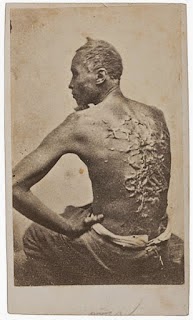
Greed can have far-reaching and long-lasting effects as demonstrated by two industries that have had a massive impact on the world - sugar and petroleum. These two industries have been powerful enough to influence the global policies of the world's leading nations. We're aware of the role Big Oil has played and continues to play in the world, but the role of the sugar industry has faded along with the past. From the 16th through the 19th centuries, approximately 12 million Africans were shipped across the Atlantic to work sugar estates primarily. The Atlantic slave trade was the largest forced immigration in human history.

Below is a picture of whipping scars on the back of a U.S. fugitive slave named Gordon. This is a mild punishment compared to some punishments that were inflicted upon West Indian slaves.

Photo: http://usslave.blogspot.com

My story weaves between 1802 (the height of Britain's sugar industry) and 2010 when the BP oil spill took place. The premise is that until the world learns its lessons, until greed ceases to be a motivation, the more things change, the more they will remain the same.

If you have the stomach for it, look at these pictures in Huffington Post taken after the oil spill.